Showing posts with label Exams. Show all posts

Sunday, August 9, 2015

How I Learned to Stop Worrying and Love Step 2

First of all, you know how everyone says Step 2 is much easier than Step 1? They are correct. If you were conscious during your 3rd year clerkships and you spend a reasonable amount of time studying, you will be able to get a better score than you did on Step 1. Many people have asked me how I studied for Step 2, so I decided to write a quick blog about.

(Disclaimer: If you’re applying to Ortho, Neurosurg, Derm, or Ophtho, none of this applies to you. You just need to talk to one of your people.)


I chose not to take any time off to prepare for Step 2 because I had a six-week Psychiatry rotation at the end of 3rd year.  This rotation is lovingly referred to as “Psych-cation” because the hours are pretty amazing (usually 8:30-ish to lunchtime). In other words, I knew I would have time to study. So I scheduled Step 2 for June 29th, which was three days after my Psych shelf, and two days before the first day of 4th year.  (Yay! One day of vacation!)


I ordered First Aid for Step 2 CK and Step 2 Secrets. (I didn’t use the latter very much, although it is a good resource and has great derm pictures.) Because I had used UWorld for my 3rd year clerkships, I reset the Qbank and started over. The Step 2 Qbank has ~2,200 questions and I studied about six days per week, so I ended up doing ~60 questions per day on the days that I did study.

When I first started studying, I needed to refresh my memory on general concepts, so I would choose a chapter in First Aid and spend an afternoon reviewing the topic in details. I also referenced my First Aid for Step 1 often (I know, I know), because it usually has more detail than the Step 2 book. I also reread Pestana. For everything else, I referenced UpToDate or Medscape.

I completed the entire Qbank in untimed tutor mode. This is because I was using UWorld as a study aid, not as a way to practice test-taking strategies. (After taking seven shelf exams during 3rd year, I felt pretty confident in my time management.) I took my time on topics that I knew I struggled with (i.e. renal), but I sped through questions that I knew well, or missed only because I made a silly error.

Two weeks before my test date, I bought an NBME practice test and did well on it. I didn’t use any of the practice tests for Step 1, and I don’t have a good reason for why I chose to do it this time. I just felt like it. Then, two days before my test I took another NBME practice test and I did NOT do well on it.

I. Freaked. Out.

My predicted Step 2 score was lower than my Step 1 score, which is obviously not a good thing. I texted people. I almost cried. One of my friends advised me to take another practice test before deciding to push my test back, so I took the UWorld Step 2 Self Assessment. I got a good score on that, breathed a sigh of relief, and stopped studying. And the rest is history.

If I could change one thing about how I prepared, I would NOT take the NBME practice tests. That freak-out was not worth it. Everything else worked really well for me. I ended up scoring 19 points higher on Step 2 than I did on Step 1 and am content with my score.


Please feel free to ask questions or share your strategies in the comments below!

Friday, October 25, 2013

Product Review: Firecracker


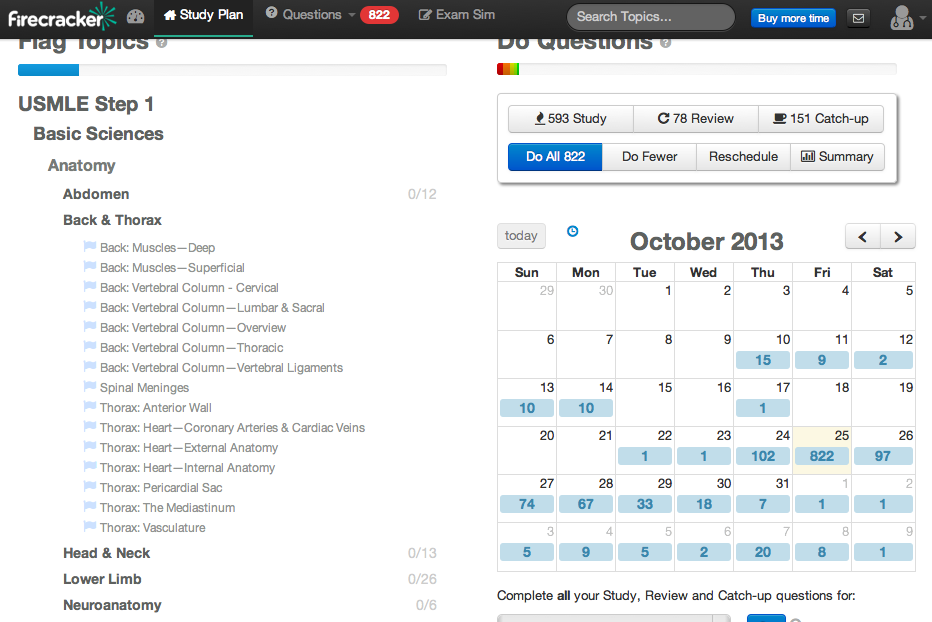
At the beginning of this semester, a classmate told me about a website called Firecracker. All he really told me was that it’s a website that supports premed (MCAT) and medical school (Step 1) test prep by helping you review material daily, so I signed up for the 1-month free trial to check it out.

Within minutes, I fell in love.

Here’s how it works:
  • All of the material is organized into topics that you flag after you cover them in lecture. (Note: in my experience, every testable subject has been accounted for.)
  • Each topic is associated with review questions, and the questions get added to your daily quiz as you flag topics.
  • Start the quiz.
  • Once you answer the question, you click “show answer” and the relevant material appears below the question.
  • Rank each question in terms of your level of mastery.


When you review the question answer, all relevant information pops up, along with any related images (charts, histology, etc.). I love how this is set up, because it provides immediate feedback and helps you learn as you go.

The question-ranking function is by far the most helpful feature. Questions that you haven’t mastered will be repeated more often in upcoming quizzes. However, they’re all eventually repeated to make sure you’ve committed the topic to long-term memory. For topics that you know perfectly and will never forget, you can check a box to never see that question again.

You can also customize your quizzes quite a bit. If it’s hard for you to jump from subject to subject or you’re short on time, you can select the subject(s) you want to include in your quiz. Plus, you can reschedule questions if you have a busy day.

There are a ton of other features, like the ability to search the entire website for a term, USMLE simulation exams, performance reviews, etc. But I want to finish this post sometime before dinner, so here’s my overall impression:

I wish I’d been using Firecracker during first year: it would have been immensely helpful. As a second year, this is a fantastic tool for staying current with new material and slowly adding in subjects from first year. This is the only method I’ve found that allows me to start reviewing last year’s material and preparing for Step 1 without giving myself a panic attack. Plus, a month-long free trial is definitely an adequate amount of time to use the website and decide if it works for you.

Health Scout Rating: 10/10 - STRONGLY RECOMMEND

Edit: Here is a great Tumblr post about Firecracker. It also explores the similarities with Anki (which I tried to use for a while last year). Read it if you'd like another perspective.

Disclosure: I am not employed by Firecracker and do not share in any company profits, however I am voluntarily partnering with them to help promote their product. I opted to do so because of my personal success with the website.

Saturday, October 19, 2013

How Medical School Faculty Write Exam Questions

Here are some methods I believe our lecturers use to compose exam questions. (This is the only possible explanation for some of the items that end up on our tests.)


Friday, May 10, 2013

Why I Made the Right Choice In Not Caring About My Exam Today


Because it wouldn't have mattered and right now I'm calm and well-rested.

The amount of work required is essentially determined by your grade on the block 1 exam. If you don't honor or high pass that exam, the amount of work increased exponentially.

Therefore, if you're only passing, it's wise to just pass and devote your time to other courses. (Ones that might lead to saving a life, like Micro or Physio.)

Especially if you don't think knowing the location of the dorsal longitudinal fasciculus will ever save a patient's life (...which I do not).


Friday, April 26, 2013

What I Learned in Neuro About What I Learned in Micro


Click to enlarge

Saturday, April 20, 2013

Just Take the Next Step

This goes out to all my MS2's. You're going to do great, just like you always have. Now stop freaking out!

Thursday, March 7, 2013

The Physiological Effects of Exam-Taking


NOTE: the Y axis is inversely related to level of cortisol production, heart rate and blood pressure.


Tuesday, March 5, 2013

Why I'm Not Studying


Because I studied this all morning & then took a test on it:

How to Procrastinate During Block


Drawing pictures for your blog also works.


Wednesday, February 20, 2013

Procrastination or Studying?


Sunday, December 23, 2012

What Finals Does to You


Seen on my med school class Facebook page during finals: “You know you just took an anatomy exam when you read ‘postural’ as ‘post-ural.’”

A day after my classmate posted that I was studying with my best med school friend (who’s quickly becoming my overall best friend, in part because she’s awesome and in part because I never see anyone else), and she goes, “Oh!” Laughing. “I just read ‘postural’ as ‘post-URAL!’ Like after urinating!”

LOL.

It's the little things that make studying for a national shelf exam tolerable...